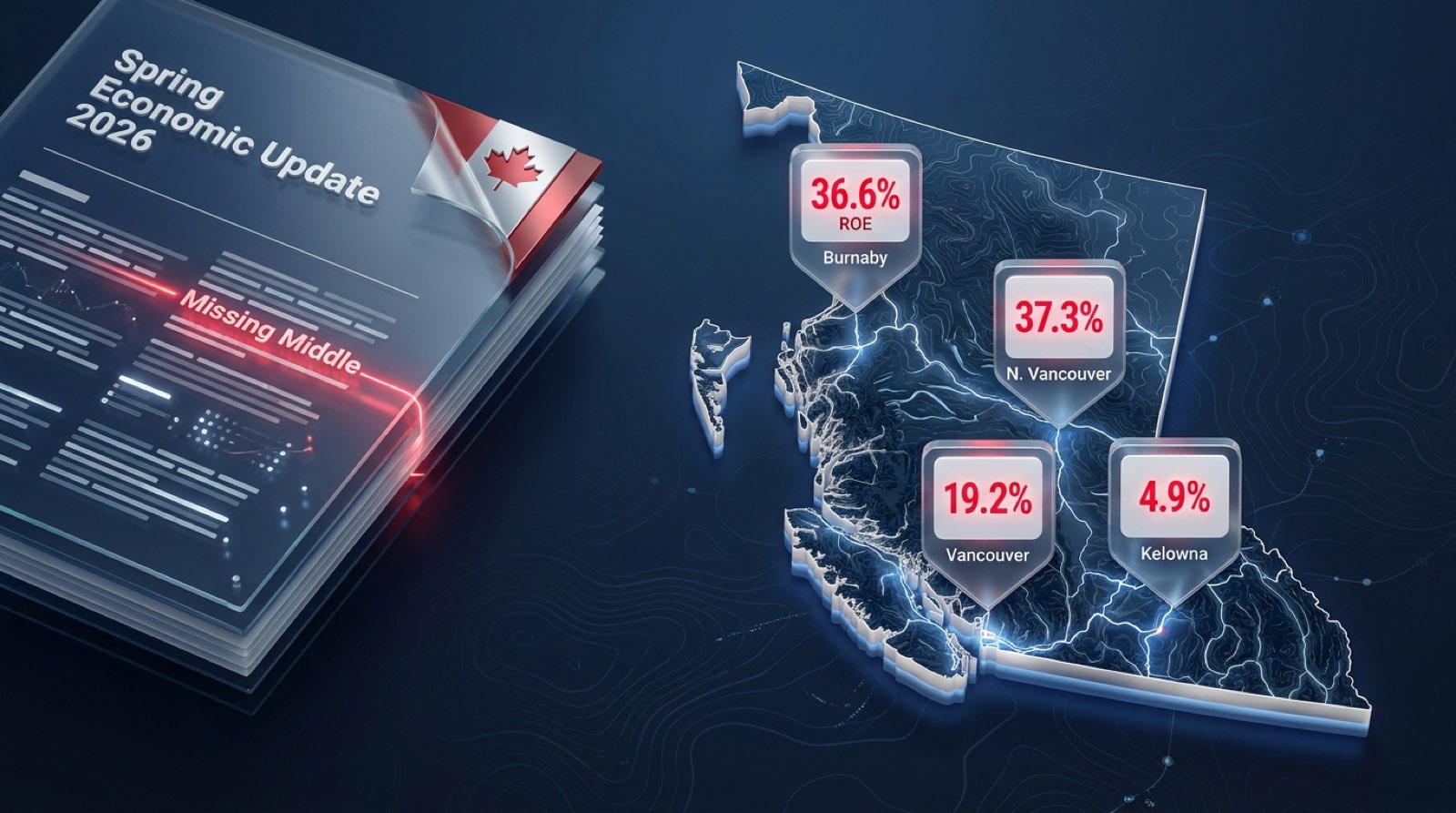
On April 29, 2026, the federal government’s Spring Economic Update used a phrase most fiscal documents never touch: missing middle. Section 2.3, “Making it Easier to Afford a Home,” directly names triplexes, fourplexes, row homes, stacked townhouses, and small low-rise apartments as essential to solving Canadian affordability. For those of us who’ve spent the last few years explaining what a multiplex actually is to lenders, regulators, and the occasional dinner-table conversation, the language in that document is new ground.
TL;DR
- Ottawa’s Spring Economic Update 2026 (April 29) named missing middle housing — triplexes through small low-rise — by name in Section 2.3.
- Two specific moves: mortgage insurance changes for 5- to 8-unit residential properties (with more flexibility for 3- and 4-unit housing), and $41.9 million over five years for homebuilding innovation including factory-built and modular systems.
- Bill 44 already gave BC the zoning piece. Ottawa is signalling the financing piece is moving. Construction innovation funding is the third leg.
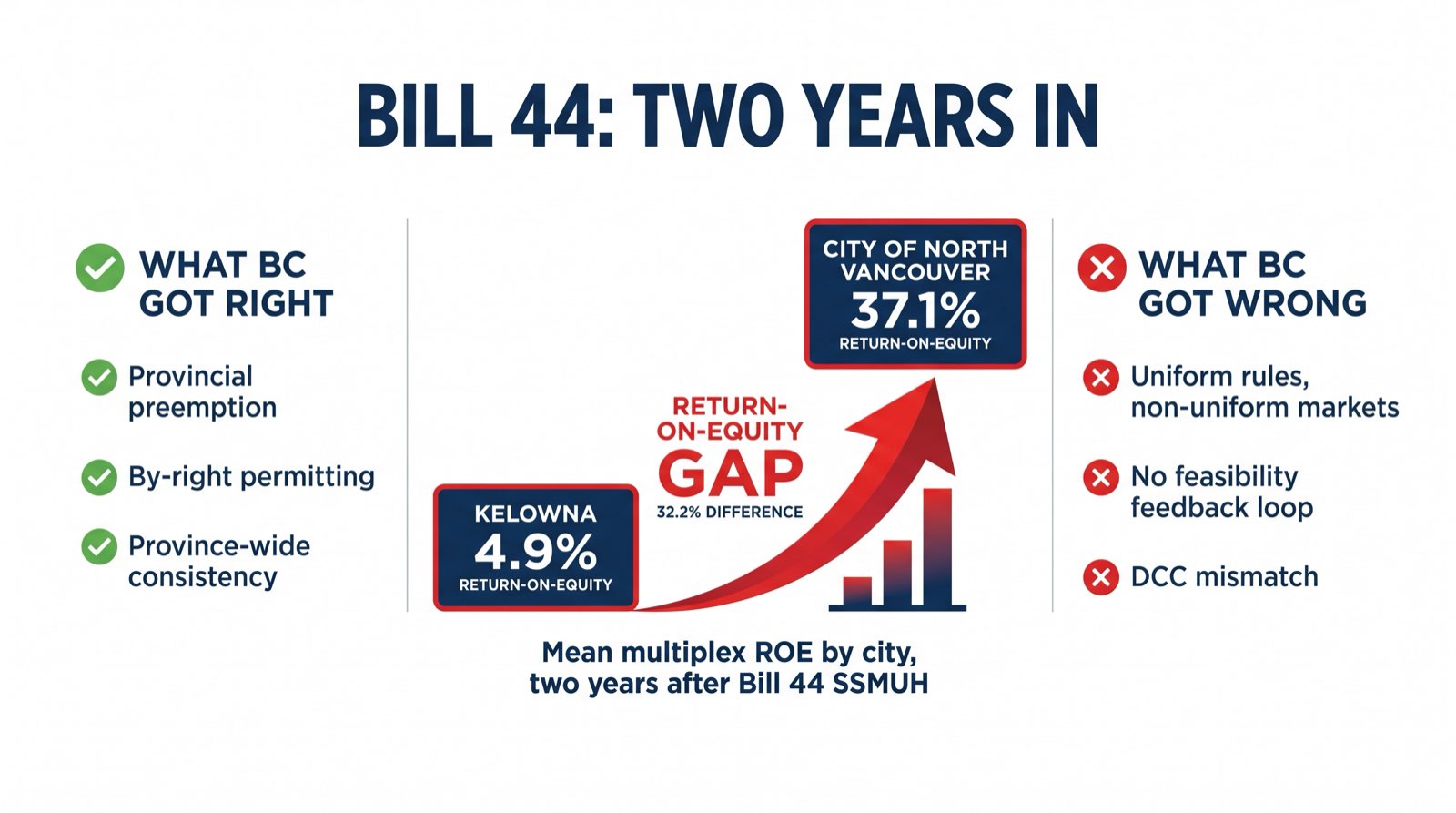
- VanPlex’s PlexRank™ scored 102,518 BC residential parcels for projected return on equity. Burnaby leads at 36.6% mean ROE; Kelowna lands at 4.9%. Same provincial zoning. Different markets.
- Federal tailwinds amplify existing market geography. They don’t rewrite it.
What Ottawa actually did
Two specific moves in the update stand out.
First, the federal government has proposed changes to mortgage insurance rules that would let private insurers offer multi-unit mortgage loan insurance on five- to eight-unit residential properties, with more flexibility for products supporting new three- and four-unit housing. In plain terms: the financing infrastructure that has long served single-family construction and large multi-family is being adapted for the three-to-eight-unit segment that sits between them.
Second, the update proposes $41.9 million over five years to support innovation in homebuilding. That includes clearer approval pathways for factory-built housing, modular and panelized systems, reduced duplicate inspections, and faster review of innovative construction products.
Small Housing, the BC-based industry organization, called the update a meaningful step. Daniel Winer, their Co-Executive Lead of Industry Activation, framed it this way: “The federal government is recognizing that gentle density is not only a zoning issue, it is also a financing, construction, and delivery issue.”
His colleague Tamara White, Co-Executive Lead of Planning Innovation, was equally clear that policy alone won’t do it: “Federal policy is moving in the right direction, but without changes to how housing is approved and delivered locally, we risk falling short of the outcomes Canadians need.”
Why this matters for the multiplex thesis
In BC, we already had the zoning piece. Bill 44 unlocked four to six units on most single-family lots across the province. What was missing was the rest of the stack: financing tailored to the asset class, lender comfort with smaller-scale residential, and construction methods that bring delivery costs in line with the unit economics.
Ottawa just signalled the financing piece is moving.
When zoning, financing, and construction innovation start moving in the same direction, that begins to look like a structural window for the asset class. It’s the convergence multiplex investors have been asking us about for the last 18 months.
The local data reality — what 102,518 parcels say
A federal financing unlock applies to the whole country. Bill 44 zoning applies to most BC residential lots. Neither one tells you where a specific parcel actually pencils.
That’s where we’ve spent most of our analytical time at VanPlex. PlexRank™, our internal lot-screening platform, has now scored 102,518 residential parcels across four BC cities for projected return on equity under current zoning. The Q1 2026 snapshot tells four very different stories about what zoning enables versus what the market actually supports.
| City | Mean projected ROE | Median projected ROE | What the distribution says |
|---|---|---|---|
| Burnaby | 36.6% | 32.0% | Right-skewed. Broadly feasible across the city. |
| City of North Vancouver | 37.3% | 19.0% | Wider spread. Selectivity matters more. |
| City of Vancouver | 19.2% | 15.0% | Tighter than its neighbours. Parcel selection is decisive. |
| Kelowna | 4.9% | — | Compressed distribution. Market does not support what zoning permits. |
Burnaby is the headline. A 36.6% mean and 32.0% median, with a right-skewed distribution, means a meaningful portion of the city’s residential lots support multiplex economics under today’s land prices and construction costs. In our data, this is the most broadly feasible market of the four.
City of North Vancouver shows a similar mean (37.3%) but a much wider spread. The 19.0% median tells you there’s a smaller core of strongly feasible parcels and a longer tail of marginal ones. Selectivity matters more here than in Burnaby.
City of Vancouver — the city most associated with the multiplex story — is, in our data, tighter than its neighbours. Mean 19.2%, median 15.0%. Real opportunities exist. Parcel selection matters more than it does in Burnaby.
Kelowna is the cautionary tale. Mean projected ROE of 4.9%. Despite the same provincial zoning unlock, the distribution is heavily compressed. The market does not support, at current land prices and construction costs, what the zoning permits.
Zoning is necessary. It isn’t sufficient on its own. The same Bill 44 framework produces 36.6% mean ROE in Burnaby and 4.9% in Kelowna. The difference is local market depth, not provincial policy.
What this means for capital
The federal Spring Economic Update is genuine validation of the asset class. The proposed financing changes, if implemented as outlined, will widen the pool of capital that can participate efficiently in three-to-eight-unit projects. That’s a tailwind we’ve been positioning for.
What it doesn’t change is the underlying geography of where multiplex actually performs. Federal tailwinds amplify existing market geography rather than rewriting it.
For investors, this is the part that gets undersold in most coverage. The opportunity is more precise than “BC multiplex” as a category. It’s defined by the specific subset of BC parcels in the specific cities where zoning, market depth, and construction economics align. That subset is large enough to absorb significant individual and small-group capital, and structurally too small and too fragmented for institutional capital to access efficiently. It sits in the gap between what large funds can deploy and what individual buyers can underwrite alone.
How much would CMHC-style insurance really change things?
The honest answer: it depends on which segment of the multiplex stack you’re in.
For a homeowner-developer building four to six units on their own lot, the proposed insurance changes mostly improve permanent financing on completion — the takeout from construction debt to a long-term mortgage. That’s a meaningful spread improvement on annual rental returns, but it doesn’t reach back into the construction phase.
For build-to-rent at 5+ units, where the takeout is the whole investment thesis, insured permanent financing is the unlock. It compresses the cost of capital on the most leveraged part of the project lifecycle.
For off-site and modular construction, the homebuilding innovation funding is the lever. The economics of factory-built multiplex don’t pencil today against stick-built in most BC markets. If the federal money meaningfully shortens approval pathways and removes duplicate inspections — and that’s a real “if” — modular’s cost advantage finally has a real shot at translating into delivered savings.
The window that just got wider
When the federal government starts naming our asset class by name in its fiscal update, that’s a cue. The macro tailwind is real. Local execution discipline is what turns it into returns.
If you’re a homeowner with a Vancouver, Burnaby, or North Vancouver lot trying to figure out whether your specific property pencils — that’s exactly what PlexRank™ was built to answer. Run your address through the tool and see where you sit on the distribution before a federal financing change makes everything noisier.
Check your lot’s projected ROE →
Sources
- Small Housing, “Small Housing Applauds Federal Recognition, Support for Gentle Density,” April 29, 2026.
- Government of Canada, Spring Economic Update 2026, Section 2.3, “Making it Easier to Afford a Home” (per Small Housing’s analysis).
- VanPlex PlexRank™ Q1 2026 snapshot: 102,518 BC residential parcels scored across four cities.
David Babakaiff is Co-Founder of VanPlex and a 2024 HAVAN Award winner. PlexRank™ | Profit with Multiplex.